Leading with Purpose: Transforming Healthcare through Executive Presence
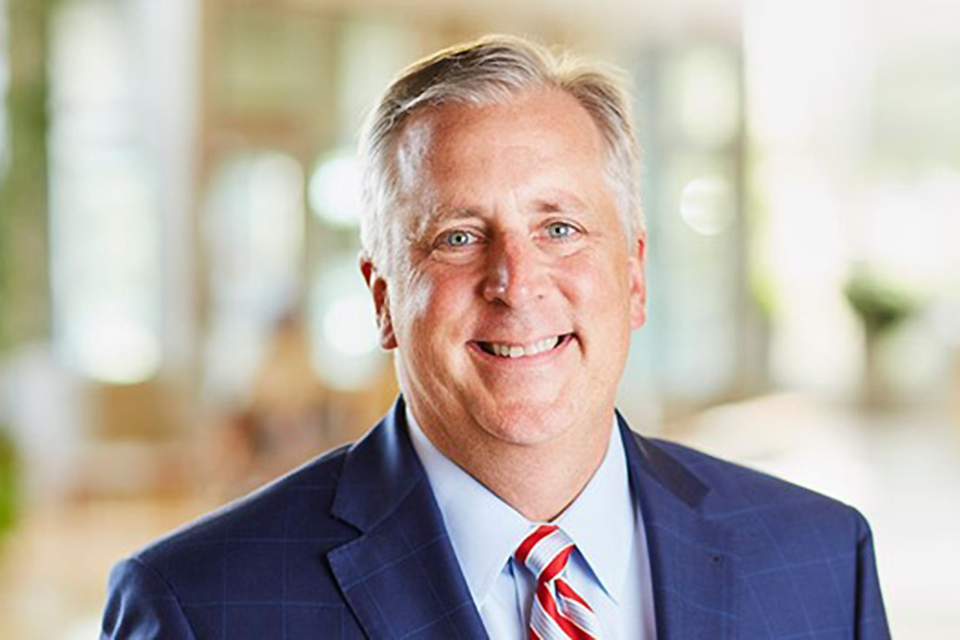
Sean Hogan (M.H.A. ‘90) is the president of Mercy South Communities, serving a broad spectrum of coordination and responsibilities across south St. Louis County, Jefferson County and southern Illinois.
Hogan, a 1990 Master of Health Administration graduate from Saint Louis University, joined Mercy in September 2018 as president of St. Anthony’s Medical Center shortly before the transition to Mercy South.
Before joining Mercy, he worked at SSM Health for 19 years, including a stretch as president of SSM Health DePaul Hospital. He also worked for Providence Health System in Portland, Oregon, before returning to St. Louis.
In addition, he serves as a board member for Notre Dame High School, Mid-America Transplant, Incentive Concepts, Commercial Bank and the Missouri Hospital Association.
Recently, the Mercy South community grew to include all physician practices, and hospital-based specialists and primary care physicians and offices. Hogan now leads his team collaboratively while determining the needs for the entire southern community in the Mercy umbrella.
Now, Hogan is responsible for coordinating services that include financial performance, quality metrics, experience scores, and growth, with the help of 10 senior executives.
He manages this workload and team through an executive presence of followership and leadership.
“That starts with building a team with a like-minded approach to accomplishment of goals,” Hogan said. “Some leaders are very hierarchical in their approach and others are more team-oriented. I don’t believe that one is far superior to another, they are just different and how the team is built around the skill sets and talent profiles that blend the styles the best are the teams that I’ve seen have the most success over my career."
His leadership style is heavily weighted toward a team-based approach with a focus on building trust among colleagues.
To grow and improve these metrics, Hogan builds a vision of where clear communication with objective measures and tactics will result in goal achievement.
“The important elements are that my team understands, agrees, and trusts that this is mission-critical for our organization. They also know that through achievement that success will be shared with all of them,” he said. “And most importantly, our community expects and deserves the level of experience that we’d all like to experience.”
Hogan’s style of implementation of executive leadership and presence blooms from relying on his persuasive and strategic gifts and deploying them as a complement to attention to detail and process orientation.
It truly is a team effort, but the driving force and main artery of communication comes from his leadership.
Hogan believes that the critical characteristics of his leadership and executive style are confidence, humility, respecting differences, and unity.
None of us are above others on a team. We all have roles, but all roles are important. I’ve worked long enough with people who have vastly different strengths than I do to realize that their opinions matter and will ultimately lead to better outcomes,” he said.
“We can argue, but when we need to create followership across an organization, it’s critically important that we support the process and the challenges that it may create.”
Hogan’s journey to becoming the leader he is and aspires to be was jump-started at SLU. His advice to current and future SLU M.H.A. students is simple: understand yourself, observe others and find a mentor.
Being able to understand yourself and building on the strength you already possess is important but observing other leaders and adapting their proven styles will help enhance your career journey, Hogan says.
The M.H.A. program at SLU helped Hogan find his confidence in a certain style of executive presence. Three things stood out to Hogan from his time at SLU. The diversity of his class, the team-based learning, and the wealth of knowledge in advising all helped Hogan find a home at SLU.
It was this experience that helped kick-start his career.
His class at SLU in the M.H.A. program contained physicians, nurses, mid-careerists, business students, and current executives. This allowed him to learn all the roles involved in health care and hospital administration. Leaning on the diversity in background allowed for a positive experience learning as a team and working together while developing close relationships with advisors to help foster learning in this setting.
From SLU to Mercy South, the learning and motivation have never stopped for Hogan.
“My family and friends depend on the great care that we provide and when we achieve the results that we’ve achieved, it just reinforces the drive to be better,” he said.
College for Public Health and Social Justice
The Saint Louis University College for Public Health and Social Justice is the only academic unit of its kind, studying social, environmental and physical influences that together determine the health and well-being of people and communities. It also is the only accredited school or college of public health among nearly 250 Catholic institutions of higher education in the United States. Guided by a mission of social justice and focus on finding innovative and collaborative solutions for complex health problems, the college offers nationally recognized programs in public health and health administration.